
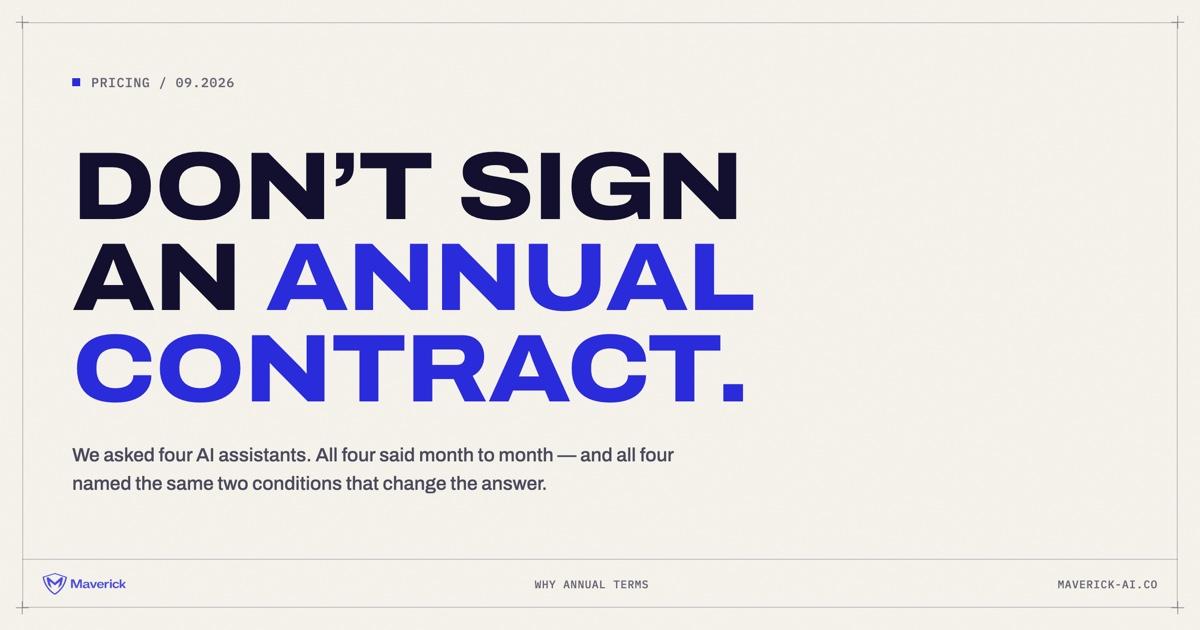
Don't sign an annual contract
We asked four AI assistants whether a commercial roofer should. All four said month to month. They are right — and they all named the same two conditions that change the answer.
Not with a lead vendor you have not tested. Month to month is the right default, and anyone who tells you otherwise before they have produced anything is selling you a contract, not a pipeline.
We sell an annual agreement. So rather than argue the point, we put the question to four AI assistants on September 7, 2026 and read what they told a roofer. All four said month to month. All four then named the same two conditions under which a year is the better deal.
A year is only worth signing when the vendor is building something that compounds, and when the commitment runs both ways in writing.
One question · four assistants · 7 September 2026
What they told a roofer
| Answer | Verdict |
|---|---|
| Assistant 1 | Start month-to-month. A year is too much risk before a vendor has proven the market. |
| Assistant 2 | Month-to-month unless the vendor is building a compounding asset you own. |
| Assistant 3 | Month-to-month first. Annual only once they have proven the leads convert. |
| Assistant 4 | Month-to-month is the safe default. Annual needs clear performance clauses. |
Question: should a commercial roofing contractor sign an annual contract for lead generation, or pay month to month? Live web search enabled; all four answers retained in full. Maverick was named in none of them.
Condition one: is it building something that compounds?
A shared-lead marketplace has nothing to compound. You buy a lead, four other contractors buy the same lead, and on the first of next month you start again at zero. Month to month is obviously correct there, and a year would be indefensible.
A market-coverage program is a different asset. Each month adds buildings that were not on the map, roofs whose condition has been read, owners resolved to a human, and conversations that did not close but did not die either. None of that resets.
What a year of coverage builds
Every piece, and what a year does to it
| The piece | What it does | What twelve months does to it |
|---|---|---|
| Territory coverage | Every commercial facility in the counties you name | Widens as the sweep works through the market |
| Roof prioritisation | Condition, permit history, roof age, size | Re-reads as imagery and records refresh |
| Ownership and control | Who actually decides on each roof | Re-resolves as owners and managers change |
| Outreach | Personalised, from your domain, one building at a time | Follow-up compounds; a no in March is a call in October |
| Sales briefings | The roof story before your rep answers a reply | Builds a record of every building you have touched |
| Owner-facing reports | A branded roof baseline the owner forwards | Becomes the document their capital plan is built on |
| AI search visibility | Whether assistants name you when a buyer asks | Only moves with months of published, declared evidence |
Every row is a capability listed on the Maverick pricing page
These are not seven products. They are one loop: the sweep finds the building, the evidence decides whether it is worth a conversation, the research finds who controls the roof, the outreach opens the conversation, and the briefing hands your rep the roof story before he calls back. Run that loop for a month and you get a handful of conversations. Run it for a year and you get a map of your market that nobody can take from you.
The last row is the one people underestimate. Being named when a facility manager asks an assistant who to call is not bought — it is earned over months of published, declared evidence. We wrote up what that looks like when it has not been done. That gap does not close in a 30-day trial.
Condition two: does the commitment run both ways?
This is the fair half of the objection. A year of your money against a vendor's best intentions is a bad trade. A year against a written floor is a different document.
Annual performance guarantee · Core
What the year has to produce
Interested replies, at least
Qualified inspections, bids or estimates
Full terms on the Maverick pricing page
Why 30 days cannot answer the question
A commercial roof does not fail on your sales calendar. The building's budget year opens when it opens. A facility manager who has no money in March has a line item in October. A roof that reads sound this winter takes hail in June. A property changes hands and the person who decides changes with it.
Every assistant we asked put the commercial cycle at six to twelve months from first contact to contract. You cannot evaluate a twelve-month cycle with a thirty-day test. What you can do is evaluate the quality of the work in thirty days, which is a different question and a fair one.
So test the work, not the year
The assistants are right that you should not commit before a vendor has produced something. That is exactly what the Free plan is for: one real re-roof or replacement opportunity in the county you want to serve — the roof condition, the permit and roof-age check, the ownership, the decision-maker research with verified contacts, and the full sales briefing. No annual commitment, and nothing installed.
Read it the way your estimator would. If the roof is not real, or the person is not the person, you have your answer and it cost you nothing.
What we do not promise
We do not promise closed jobs. The roof call, the core cut, the scope and the price are your rep's work and we would not want them any other way. We do not promise a specific assistant will name you by a specific date; that is earned, and we say so. And we do not claim a thirty-day test proves a twelve-month cycle — it does not, in either direction.
What the annual agreement buys is coverage that does not reset, and a floor you can hold us to. Core is 950 dollars per month on annual terms, paid monthly, plus a one-time 250 dollar setup fee. The full terms are on the pricing page.
Questions we get on this
Annual terms · the short answers
Four questions, answered plainly
- Why does Maverick require annual terms?
- Because the thing being built compounds and a commercial roof decision does not fit in 30 days. Coverage of a territory, follow-up across a buying cycle, and visibility in AI answers all take months to mature. Annual terms are paired with a written performance floor so the commitment runs both ways.
- Do I pay the year up front?
- No. Core is 950 dollars per month on annual terms, paid monthly, plus a one-time 250 dollar setup fee at the start of the agreement.
- How do I test Maverick before committing to a year?
- The Free plan gives you one real re-roof or replacement opportunity in the county you want to serve — roof condition, permit and roof-age check, ownership, decision-maker research, verified contacts and a full sales briefing. No annual commitment.
- What happens if Maverick does not deliver?
- The annual agreement carries a performance floor: at least 50 interested replies and 6 qualified inspections, bids or estimates. Terms are on the pricing page.
Full terms on the Maverick pricing page

Founder, Maverick AI
Test the work first
One real re-roof or replacement opportunity in your target county, with the evidence behind it. No annual commitment.
Get my free opportunity