
 Case study 03 · Aurora & Denver, Colorado
Which of nine HOA communities took the hail
A portfolio manager’s associations screened against dated National Weather Service reports — and two dropped despite real hail, because in a detached subdivision the roofs belong to individual homeowners, not the board.
- HOA portfolio manager
- Attached-housing community
- Detached subdivisions
A property manager does not buy a roof. She controls access to the boards that do — so the useful thing to hand her is not a pitch, but an answer to the question she actually asked.
Molly Ryan, CMCA, is President of Metro Property Management in Aurora, Colorado. Her question to Apex Roofing was narrow and practical: “What is the name of the community or the intersection where they are located?” She manages a portfolio of associations. Before she can take anything to a board, she needs to know which of her communities is affected, and where it is.
The correction that came first
Rule: own the mistake in the deliverable, not in a follow-up call
Apex’s original outreach had said it noticed possible storm damage “at your site.” The address on file was 10800 E Bethany Drive — Metro’s own office suite, not a community it manages. No Metro property had been inspected, and the note should have said which one it meant.
That correction is printed on page two of the report, above the findings. Then the work was redone properly: pull the managed associations from the Colorado Division of Real Estate HOA registry, locate each one, and measure every one against National Weather Service local storm reports.
How the communities rank
Rule: two filters — distance to damaging hail, and who owns the roofs
Hail cores are narrow. A report four miles away says very little about a specific roof; one under a mile says a great deal. But distance alone would rank this portfolio wrong, because a detached-home subdivision can sit in the middle of the storm and still not be an association roofing project — each homeowner owns their own roof.
Cinnamon Village is missing from the table on purpose. The only address the registry carries for it is a mailbox suite on South Buckley Road, which says nothing about where the homes are — so it was left out rather than guessed at.
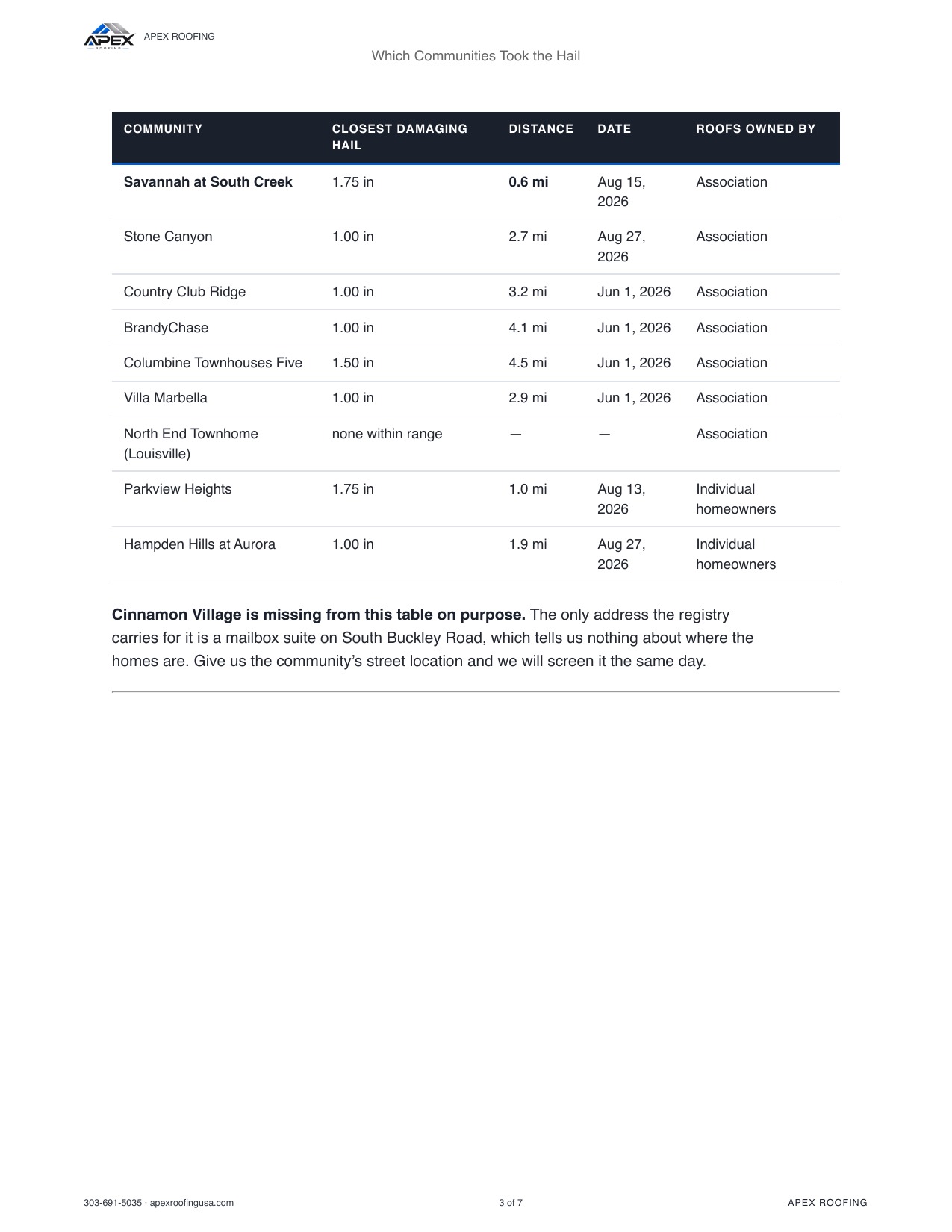
The same ranking as delivered to the manager.View full page →
The one to look at first
Savannah at South Creek · off East Jamison Drive
On August 15 a ground observer reported 1.75 inch hail six-tenths of a mile from it, and on August 13 another reported 1.00 inch nine-tenths of a mile away. Nothing else in the portfolio is that close to stones that size.
The aerial settles the second filter. It is a large attached-housing community — a dozen and more multi-unit buildings on asphalt shingle hip roofs, with a shared pool and playground. Asphalt shingle is the covering most readily bruised at 1.00 inch and above. Because the buildings are attached and the roofs are common elements, this is one decision by one board covering many roofs, not thirty separate homeowner conversations.
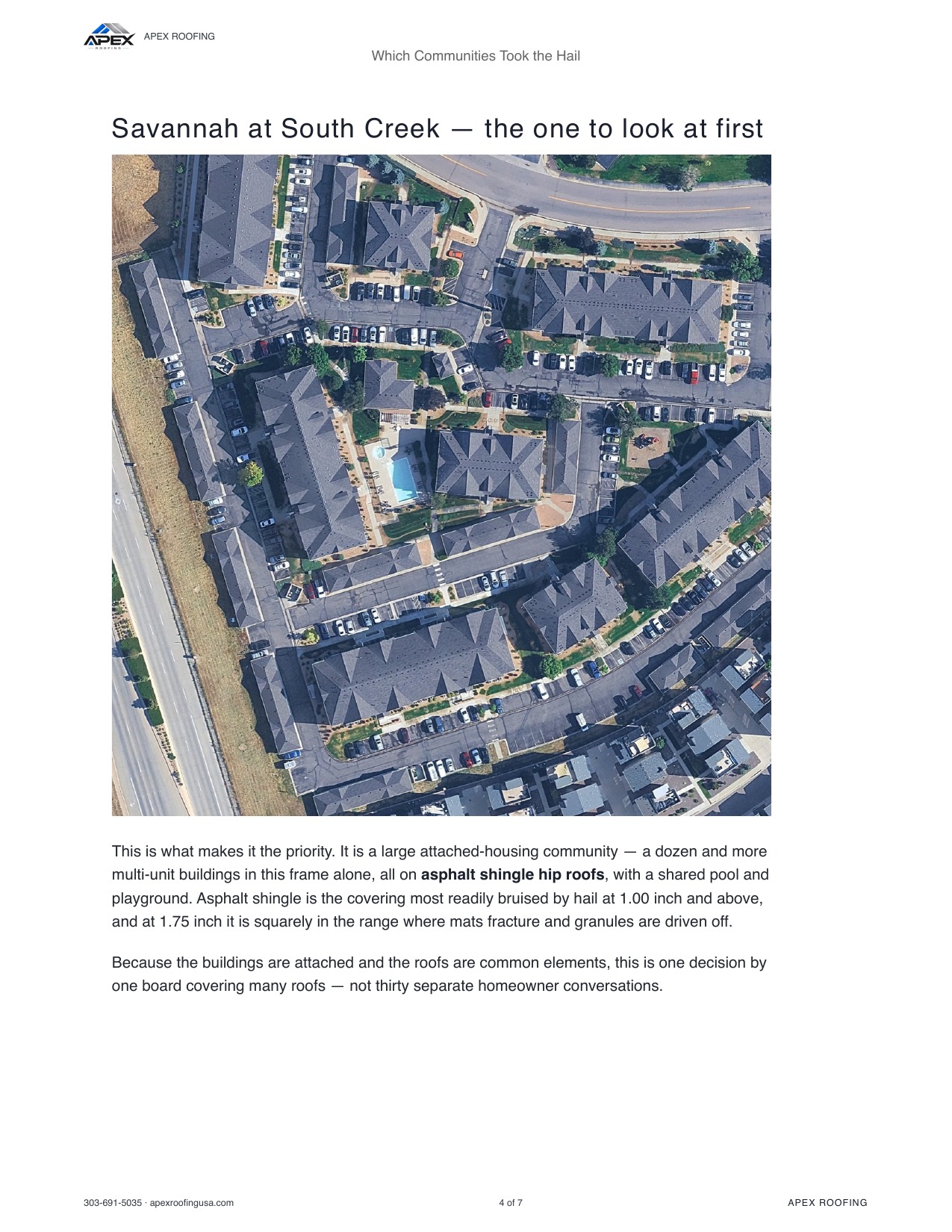
No imagery held shows these roofs after August 13 — which is the report’s own argument for why the next step happens on a ladder rather than at a desk.View full page →
Where the storm hit but the roofs are not hers
Parkview Heights took the closest severe report of anything in the portfolio — 1.75 inch hail one mile away on August 13 — and it still is not a board project. The aerial shows detached single-family homes. Same for Hampden Hills at Aurora, whose registered address turned out to be a single detached house on South Genoa Circle.
Ranked on storm exposure alone, those two would have gone to the top of the list and wasted the manager’s time. Instead the report says plainly that the association almost certainly does not own those roofs — and offers the thing that does fit: a documented inspection day where homeowners opt in individually and the association carries none of the cost.
What the report refuses to claim
Rule: a hail report proves a stone fell nearby, not that a roof is damaged
The last page is the one that makes the rest credible. No Metro community had been inspected, nothing in the document is an insurance opinion, and only someone on the roof can say whether shingle mats are bruised or granule loss has gone past normal weathering.
Two limits are named outright: absence of a hail report is weaker evidence than presence of one, because reports depend on somebody being there to file them; and where a registry address is a mailbox rather than the community, the report says so rather than guessing.
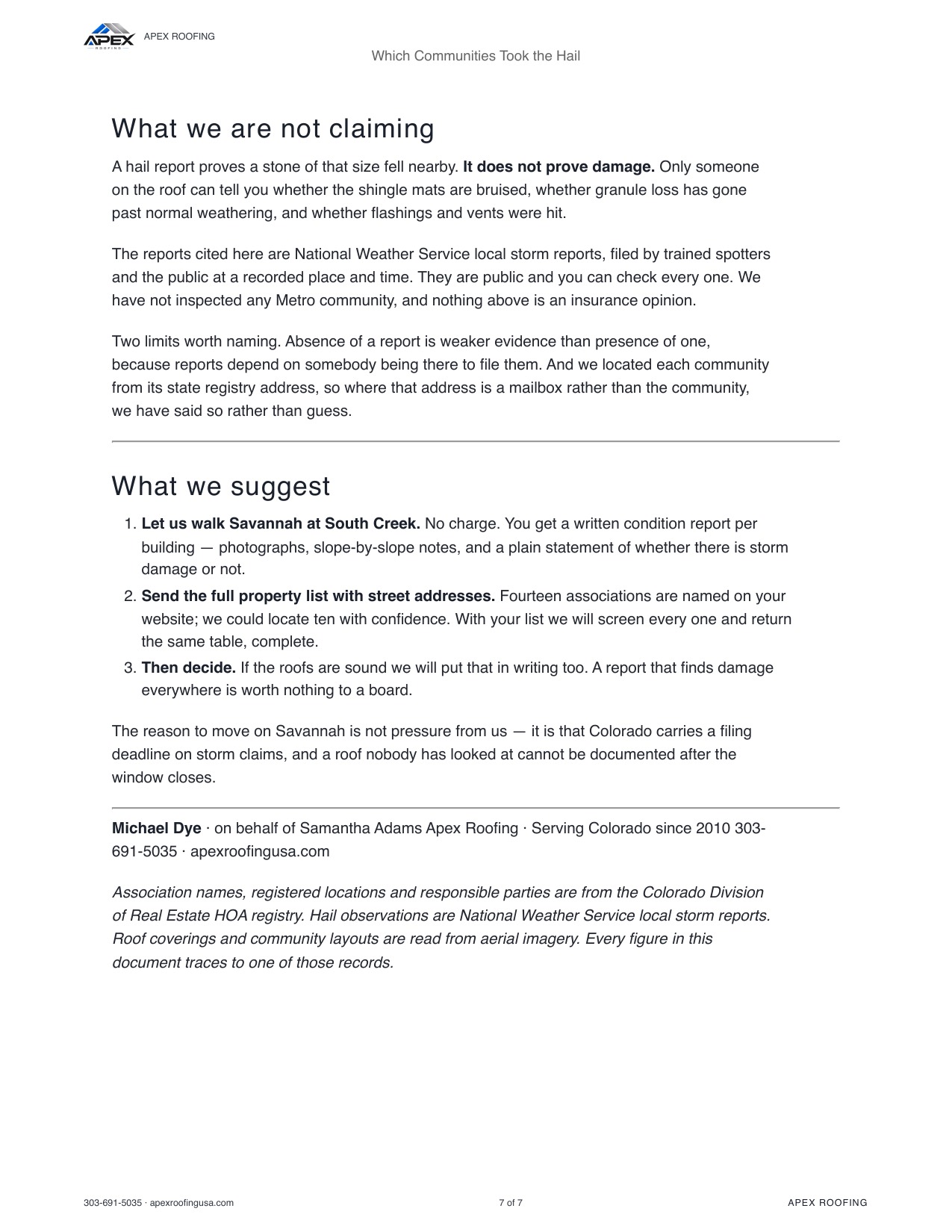
Every figure in the document traces to a public record — the state HOA registry, National Weather Service storm reports, or aerial imagery.View full page →
Nine associations located and screened against dated hail reports, one community identified as the priority walk, two correctly ruled out as homeowner-owned rather than board projects, and a request back to the manager for the full property list so the remaining associations can be screened the same way.
This report documents storm exposure and prioritisation — not inspections performed, damage found, contracts awarded, or revenue. No Metro community had been inspected at the time of writing.
Want the next case study?
Start with one real re-roof or replacement opportunity in your target county — free.